

What Is the Best Creatine for Women? A Buying Guide
You don't need a special women's formula. You need real monohydrate, a dose you can count, independent lab testing and a format you'll actually take every day.
What does creatine do for women?
Paired with strength training, creatine helps women build more muscle and strength than training alone [2][6]. In young female athletes, creatine also improved jumping and change of direction speed [7].
Creatine doesn't replace the training. It adds to what the training builds.
+7.5 kg
leg press strength
Postmenopausal women, 2026 meta analysis of 7 trials in 608 women (3 trials for strength), with 5g a day or more and resistance training [2]
+0.37 kg
lean mass
Same 2026 meta analysis, 5 trials, on top of what training alone added [2]
+1.37 kg
lean tissue
22 trials, 721 adults with average ages of 57 to 70, creatine plus resistance training versus training alone [6]
17 female beach volleyball athletes took 5g of creatine a day as gummies for 10 weeks. Compared with 15 who took nothing, their jump height and change of direction speed improved [7]. It had no placebo and the gummies were donated by their maker, so count it as an encouraging start.
No. Same creatine, same dose.
The benefits in women came from plain creatine monohydrate, the same ingredient used in trials of men. Monohydrate was the form in 275 of 343 creatine trials (80.2%) [3], and a 2022 critical review concluded it is still the only source of creatine with substantial evidence for its absorption, effectiveness and safety [8]. The International Society of Sports Nutrition has no separate dose for women [1].
What this means for you: pay for real creatine monohydrate and the right dose. A label aimed at women isn't what the research tested.
"There is no scientific reason to take a creatine supplement other than creatine monohydrate."
What should you look for on a creatine label?
Look for creatine monohydrate, the grams of creatine in each serve and independent lab testing. Then count how many scoops, capsules or gummies make 3 to 5g a day [1].
Why the fuss about testing? Product testing of other brands' gummies, none of it peer reviewed, has found some of those gummies short of the creatine on their label [11][12]. Creatine is less stable in gummy making than as a dry powder [8]. That's why we say choose a lab tested gummy.
Label checklist
The form
Creatine monohydrate on the ingredient list. It's the form with the research behind it [8].
Dose per daily serve
Australian rules cap a labelled serve at 3g of creatine, so count your daily total, not the labelled serve.
Gummies or capsules per serve
Check the grams of creatine in each piece, then work out how many make 3 to 5g.
Independent testing
A brand that tests will usually tell you which lab did the work.
Sugar
Check the sugar per serve, especially if you take several gummies a day.
Powder, capsules or gummies: which creatine is best?
Each format delivers the same creatine monohydrate, so at the same dose you'd expect the same result. Creatine is close to fully absorbed [9]. The real differences are convenience, taste and what to check.
Powder
- Dose
- Set by the scoop, so check the scoop size and level it
- Convenience
- Needs water and a good stir and it doesn't fully dissolve
- Taste
- Plain or flavoured drink
- Check
- Creatine monohydrate as the only ingredient
Capsules
- Dose
- Usually several capsules a day; check the grams per capsule
- Convenience
- Swallowed with a drink, easy to carry
- Taste
- None
- Check
- How many capsules make 3 to 5g
Gummies
- Dose
- Usually several gummies a day; check the grams per gummy
- Convenience
- No water, no shaker, no scoop; a bag fits in your handbag or gym bag
- Taste
- Like a lolly
- Check
- Independent lab testing, grams per gummy and sugar per serve
Here's the honest case for gummies. The best creatine is the one you actually take every day. No study has tested whether gummies help people take creatine more consistently, so we won't claim they do. But if a tub tends to sit in your cupboard, a format you enjoy and can carry anywhere is the one that does its job.
What are the side effects of creatine for females?
For healthy women, side effects are uncommon. A review of 29 studies in 951 women found no deaths or serious adverse outcomes and no significant difference from placebo in total side effects or stomach problems [13].
Weight gain is the only side effect consistently reported in the research [1]. Large single doses can upset the stomach, so split larger amounts into servings of about 5g [15]. At the usual 3 to 5g a day, that's a single dose.
As with any supplement, talk to your doctor first if you're pregnant or breastfeeding, have kidney disease or take regular medication.
13.7% vs 13.2%
Creatine groups versus placebo groups, not a statistically significant difference [14].
+0.86 kg
More than placebo, with no significant change in fat mass. Women and men gained about the same [5].

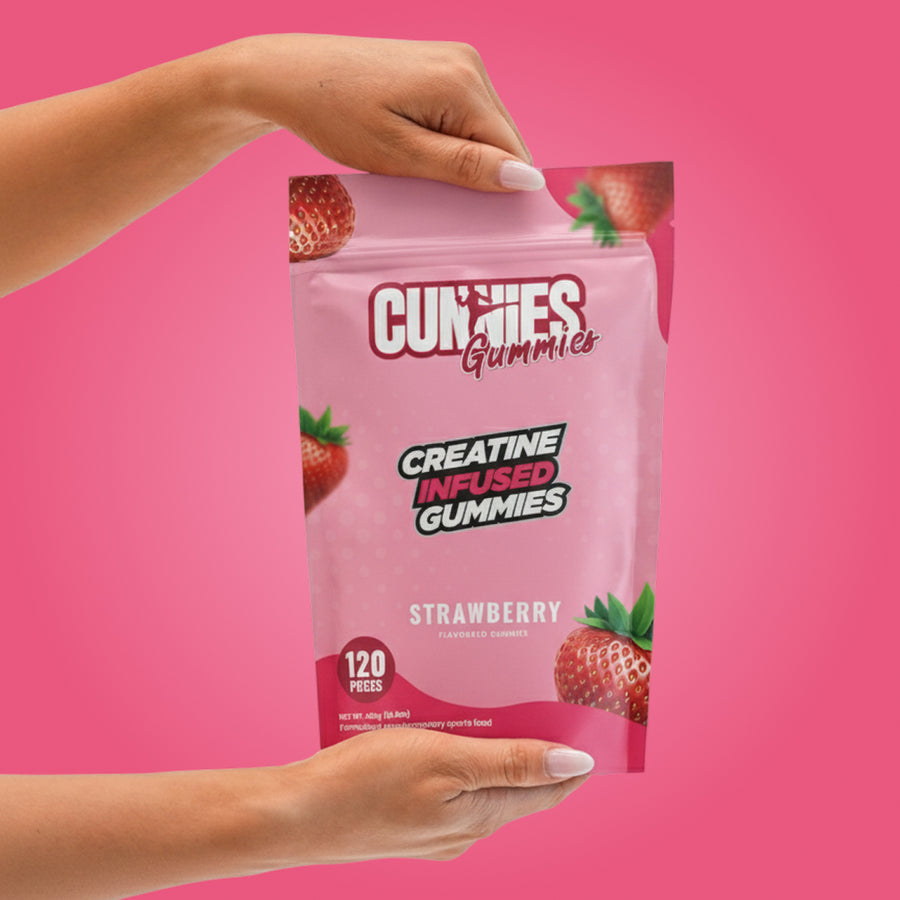
Strawberry Creatine Gummies
One gummy provides 1.25g of creatine monohydrate. Four gummies provide 5g, the daily dose used in research. The labelled serve on the bag is one gummy because Australian food labelling rules cap a labelled serve at 3g of creatine. Every flavour has the same creatine content. Lab tested by Eurofins.
Shop StrawberryQuick answers
Which type of creatine is best for women?
Creatine monohydrate. It was used in 80.2% of 343 creatine trials [3] and reviews have found little to no evidence that newer forms work better [8][9]. Take 3 to 5g a day [1].
Is creatine monohydrate good for women?
Yes. Paired with resistance training, it added an average of 0.37 kg of lean mass and 7.5 kg to leg press strength in postmenopausal women [2].
Do women need a lower dose of creatine?
No. The well established daily dose is 3 to 5g for women and men alike [1].
Will creatine make me put on weight?
A little. Trials in women averaged 0.86 kg more than placebo, with no significant change in fat mass [5]. Skip loading if you'd rather avoid the 1 to 3 kg of early water weight [10].
Our methodology
Written and checked by the Cunnies team in October 2026. We cite 12 peer reviewed papers, one Australian Institute of Sport guidance page and 2 product testing reports of other brands, labelled as not peer reviewed. An independent fact checker rechecked every figure. Some researchers cited have links to supplement companies, and one gummy trial used donated product.
References
All 15 references, with DOI and PubMed links
- Kreider RB, Kalman DS, Antonio J, et al. (2017). International Society of Sports Nutrition position stand: safety and efficacy of creatine supplementation in exercise, sport, and medicine. Journal of the International Society of Sports Nutrition, 14, 18. doi.org/10.1186/s12970-017-0173-z (PubMed: pubmed.ncbi.nlm.nih.gov/28615996/)
- Naddafha S, Antonio J, Kreider RB, Stout JR (2026). Creatine monohydrate for lean mass, strength, and bone density in postmenopausal women: a systematic review and meta-analysis. Journal of the International Society of Sports Nutrition, 23(1), 2668435. doi.org/10.1080/15502783.2026.2668435 (PubMed: pubmed.ncbi.nlm.nih.gov/42141930/)
- Bučević Popović V, Sovulj A, Raić S, et al. (2026). Methodological approaches to bioavailability of oral creatine in randomized controlled trials: a meta-research study. Nutrients, 18(16), 2697. doi.org/10.3390/nu18162697 (PubMed: pubmed.ncbi.nlm.nih.gov/42654277/)
- Australian Sports Commission. AIS Sports Supplement Framework: Creatine. Accessed 25 October 2026. www.ausport.gov.au/ais/nutrition/supplements/group_a/performance-supplements2/creatine
- Pashayee-Khamene F, Heidari Z, et al. (2024). Creatine supplementation protocols with or without training interventions on body composition: a GRADE-assessed systematic review and dose-response meta-analysis. Journal of the International Society of Sports Nutrition, 21(1), 2380058. doi.org/10.1080/15502783.2024.2380058 (PubMed: pubmed.ncbi.nlm.nih.gov/39042054/)
- Chilibeck PD, Kaviani M, Candow DG, Zello GA (2017). Effect of creatine supplementation during resistance training on lean tissue mass and muscular strength in older adults: a meta-analysis. Open Access Journal of Sports Medicine, 8, 213 to 226. doi.org/10.2147/OAJSM.S123529 (PubMed: pubmed.ncbi.nlm.nih.gov/29138605/)
- Pereira F, Forbes SC, Romano V, et al. (2026). Effects of creatine monohydrate gummies on performance and body composition in female beach volleyball athletes. Journal of Functional Morphology and Kinesiology, 11(1), 105. doi.org/10.3390/jfmk11010105 (PubMed: pubmed.ncbi.nlm.nih.gov/41900512/)
- Kreider RB, Jäger R, Purpura M (2022). Bioavailability, efficacy, safety, and regulatory status of creatine and related compounds: a critical review. Nutrients, 14(5), 1035. doi.org/10.3390/nu14051035 (PubMed: pubmed.ncbi.nlm.nih.gov/35268011/)
- Jäger R, Purpura M, Shao A, Inoue T, Kreider RB (2011). Analysis of the efficacy, safety, and regulatory status of novel forms of creatine. Amino Acids, 40(5), 1369 to 1383. doi.org/10.1007/s00726-011-0874-6 (PubMed: pubmed.ncbi.nlm.nih.gov/21424716/)
- Antonio J, Candow DG, Forbes SC, et al. (2021). Common questions and misconceptions about creatine supplementation: what does the scientific evidence really show? Journal of the International Society of Sports Nutrition, 18(1), 13. doi.org/10.1186/s12970-021-00412-w (PubMed: pubmed.ncbi.nlm.nih.gov/33557850/)
- Glenn J, SuppCo (2025). SuppCo Tested: creatine reality check, the failures we found when testing popular products (company commissioned product testing of other brands, not peer reviewed). supp.co/articles/suppco-tested-creatine-testing-results-gummies-failed-lab-analysis
- Nutritional Outlook (2024). NOW tests creatine gummies, identifies limitations in third party gummy testing (report of manufacturer in house testing of other brands, not peer reviewed). www.nutritionaloutlook.com/view/now-tests-creatine-gummies-identifies-limitations-in-third-party-gummy-testing
- de Guingand DL, Palmer KR, Snow RJ, Davies-Tuck ML, Ellery SJ (2020). Risk of adverse outcomes in females taking oral creatine monohydrate: a systematic review and meta-analysis. Nutrients, 12(6), 1780. doi.org/10.3390/nu12061780 (PubMed: pubmed.ncbi.nlm.nih.gov/32549301/)
- Kreider RB, Gonzalez DE, Hines K, et al. (2025). Safety of creatine supplementation: analysis of the prevalence of reported side effects in clinical trials and adverse event reports. Journal of the International Society of Sports Nutrition, 22(sup1), 2488937. doi.org/10.1080/15502783.2025.2488937 (PubMed: pubmed.ncbi.nlm.nih.gov/40198156/)
- Ostojic SM, Ahmetovic Z. (2008). Gastrointestinal distress after creatine supplementation in athletes: are side effects dose dependent? Research in Sports Medicine, 16(1), 15 to 22. doi.org/10.1080/15438620701693280 (PubMed: pubmed.ncbi.nlm.nih.gov/18373286/)
This article is general information, not medical advice. If you have a health condition, are pregnant or breastfeeding, or take medication, talk to your doctor before starting a supplement.
