

Is it worth taking after menopause?
Paired with strength training, the evidence shows it is. In postmenopausal women, creatine plus resistance training added more lean mass and leg strength than training alone [1].
Why talk about creatine and menopause now?
Creatine is getting a lot of attention in women's health. Researchers now study it across a woman's whole life, from menstruation through pregnancy to menopause [2].
The starting point is strong. The International Society of Sports Nutrition concluded that "creatine monohydrate is the most effective ergogenic nutritional supplement currently available to athletes" (ergogenic means performance enhancing) for increasing high intensity exercise capacity and lean body mass during training [3].
So why menopause? Muscle and bone both change faster in the years around the final period [4][5].
Perimenopause, menopause, postmenopause
Most creatine research is in postmenopausal women [2]. Stage definitions from STRAW+10, body changes from the SWAN study [4][5][6].
Cycles still regular. Body composition has not yet started the shift that comes next.
Cycles become irregular, then gaps of 60 days or more. Lean mass starts falling about 0.2% a year [4][6].
Hormones settle after about 2 years. Muscle and fat trends level off. Bone loss slows but does not stop [4][5][6].
7.38%
of the total 10.6% decline in spinal bone density over 10 years occurred within the three years surrounding the final menstrual period [5]
Say you're 49. Your periods have become irregular and your weight hasn't changed much. Yet your jeans fit differently and your usual squat feels heavier.
That picture lines up closely with the research.
What changes in your body around menopause?
Bone changes fastest. In the US SWAN study of 862 women, the lower spine lost 10.6% of its density over 10 years, with 7.38% of that loss in the 3 years around the final period [5].
Hormones and age both play a part. Oestrogen deficiency after menopause is a major cause of osteoporosis (thin, fragile bones) [8]. Some loss of spongy inner bone begins as early as young adulthood [9].
Muscle and fat shift too. In 1,246 SWAN women, lean mass fell about 0.2% a year once the transition began, while the rate of fat gain rose from 1% to 1.7% a year [4]. The change is in what your weight is made of.
Why does keeping muscle and strength matter?
Muscle and strength keep everyday life easy. Over the long run, sarcopenia (the age related loss of muscle strength and mass) increases the risk of falls and fractures and makes everyday activities harder [12].
In 232 Finnish women followed across the transition, handgrip strength fell 2.1% and knee extension strength 2.6%. Highly active women went the other way: their grip strength increased [11]. And it's never too late: resistance training improved strength just as much after menopause as before it [13].
A small backup battery for your muscles
About two thirds of muscle creatine is stored as phosphocreatine. When a hard effort uses up ATP (the molecule your cells run on), it helps rebuild it on the spot. That's why it supports training and, through training, building and keeping muscle [3].
About 95%
of the creatine in your body is stored in your skeletal muscles [3].
About half
comes from food, mainly red meat and seafood. Your liver and kidneys make the rest [3].
60 to 80%
is how full a normal diet leaves your muscle stores. 450 g of beef or salmon gives only 1 to 2 g [3].
"yields small but meaningful gains in lean mass and strength without evidence of harm"
Naddafha et al. (2026), Journal of the International Society of Sports Nutrition [1]
Benefits after menopause: muscle mass and strength
Creatine plus resistance training builds more muscle and strength than training alone. Across 22 trials in 721 adults with average ages of 57 to 70, it added 1.37 kg more lean tissue than training alone [14].
Some of the effect shows up fast. In a 2008 trial, 30 women aged 58 to 71 took a loading dose for 7 days with no training and added 1.7 kg to the bench press and 5.2 kg to the leg press. The placebo group did not change [16]. One week of loading partly reflects muscle stores filling with creatine and water, so treat it as a quick start.
It works with the weights, not instead of them.
Heavy lifting after menopause: the LIFTMOR trial
For bone, the strongest evidence is for training itself. At Griffith University, 101 postmenopausal women with low bone mass did 30 minutes of supervised heavy resistance and impact training twice a week for 8 months. They averaged 65 and worked up to 5 sets of 5 at more than 85% of their one rep max [18].
LIFTMOR tested training, not creatine. In the largest creatine bone trial, hip bone geometry held steady with creatine, but it made no difference to bone mineral density [20]. If your bone density is low, get coached and check with your doctor before you lift heavy.
+2.9%
spine bone density, heavy training group
Down 1.2%
home exercise group
How should you take creatine in menopause?
Take 3 to 5 g every day and do resistance and impact training regularly. Taken daily, creatine fills muscle stores over about three to four weeks [3].
Loading is optional and can add 1 to 3 kg of water weight in the first week [23]. Split big doses to avoid an upset stomach [25]. If you have kidney disease, take HRT or other medication, talk to your doctor first. More on safety in Is creatine safe?
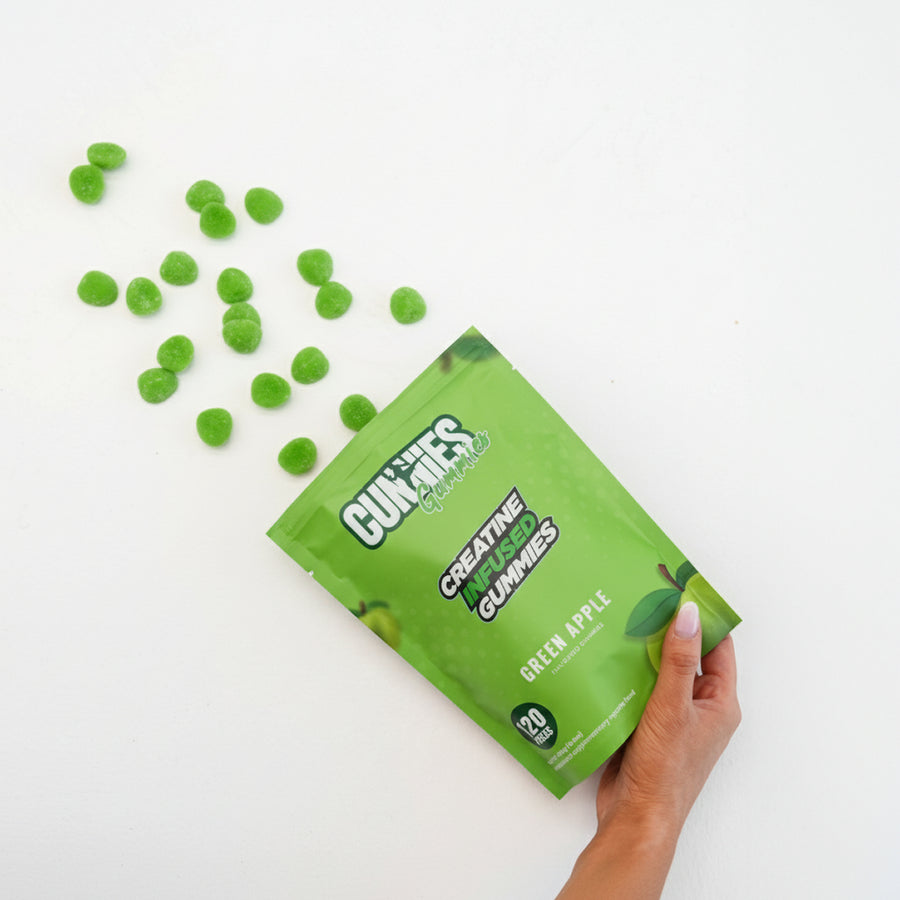
Green Apple Creatine Gummies
One gummy provides 1.25 g of creatine monohydrate. Four gummies provide 5 g, the daily dose used in research. Lab tested by Eurofins.
Shop Green AppleOther menopause symptoms
There aren't enough studies yet to recommend creatine for mood, brain fog or other menopause symptoms. The one placebo controlled trial so far was small, lasted 8 weeks and used a different form [21].
Key takeaways
01
Creatine plus training builds lean mass and strength
In 608 postmenopausal women, it added 0.37 kg of lean mass and 7.5 kg to leg press strength at 5 g a day or more with resistance training [1].
02
Training helps bone health and keeps muscle
In LIFTMOR, supervised heavy training raised spine bone density 2.9% in 8 months [18]. Strength gains are just as good after menopause as before [13].
03
Together they're a smart combination
Creatine adds to what training does for strength. However, research remains limited, especially studies in perimenopausal and postmenopausal women specifically [2].
Our methodology
We searched PubMed and ClinicalTrials.gov in October 2026 and cite 24 papers and one trial registration. A second researcher rechecked every figure against the papers. Some researchers cited have links to supplement companies.
References
All 25 references, each with DOI and PubMed links
- Naddafha S, Antonio J, Kreider RB, Stout JR (2026). Creatine monohydrate for lean mass, strength, and bone density in postmenopausal women: a systematic review and meta-analysis. Journal of the International Society of Sports Nutrition, 23(1), 2668435. doi.org/10.1080/15502783.2026.2668435 (PubMed: pubmed.ncbi.nlm.nih.gov/42141930/)
- Smith-Ryan AE, DelBiondo GM, et al. (2025). Creatine in women's health: bridging the gap from menstruation through pregnancy to menopause. Journal of the International Society of Sports Nutrition, 22(1), 2502094. doi.org/10.1080/15502783.2025.2502094 (PubMed: pubmed.ncbi.nlm.nih.gov/40371844/)
- Kreider RB, Kalman DS, et al. (2017). International Society of Sports Nutrition position stand: safety and efficacy of creatine supplementation in exercise, sport, and medicine. Journal of the International Society of Sports Nutrition, 14, 18. doi.org/10.1186/s12970-017-0173-z (PubMed: pubmed.ncbi.nlm.nih.gov/28615996/)
- Greendale GA, Sternfeld B, Huang M, et al. (2019). Changes in body composition and weight during the menopause transition. JCI Insight, 4(5), e124865. doi.org/10.1172/jci.insight.124865 (PubMed: pubmed.ncbi.nlm.nih.gov/30843880/)
- Greendale GA, Sowers M, Han W, et al. (2012). Bone mineral density loss in relation to the final menstrual period in a multiethnic cohort: results from the Study of Women's Health Across the Nation (SWAN). Journal of Bone and Mineral Research, 27(1), 111 to 118. doi.org/10.1002/jbmr.534 (PubMed: pubmed.ncbi.nlm.nih.gov/21976317/)
- Harlow SD, Gass M, Hall JE, et al. (2012). Executive summary of the Stages of Reproductive Aging Workshop + 10: addressing the unfinished agenda of staging reproductive aging. The Journal of Clinical Endocrinology and Metabolism, 97(4), 1159 to 1168. doi.org/10.1210/jc.2011-3362 (PubMed: pubmed.ncbi.nlm.nih.gov/22344196/)
- ClinicalTrials.gov (2026). NCT07027800: high intensity resistance training and creatine in perimenopausal women (University of North Carolina at Chapel Hill). Completed December 2025, no results posted as of 22 October 2026. clinicaltrials.gov/study/NCT07027800
- Khosla S, Monroe DG (2018). Regulation of bone metabolism by sex steroids. Cold Spring Harbor Perspectives in Medicine, 8(1), a031211. doi.org/10.1101/cshperspect.a031211 (PubMed: pubmed.ncbi.nlm.nih.gov/28710257/)
- Khosla S (2013). Pathogenesis of age-related bone loss in humans. The Journals of Gerontology Series A, 68(10), 1226 to 1235. doi.org/10.1093/gerona/gls163 (PubMed: pubmed.ncbi.nlm.nih.gov/22923429/)
- Juppi HK, Sipilä S, Cronin NJ, et al. (2020). Role of menopausal transition and physical activity in loss of lean and muscle mass: a follow-up study in middle-aged Finnish women. Journal of Clinical Medicine, 9(5), 1588. doi.org/10.3390/jcm9051588 (PubMed: pubmed.ncbi.nlm.nih.gov/32456169/)
- Bondarev D, Finni T, Kokko K, et al. (2021). Physical performance during the menopausal transition and the role of physical activity. The Journals of Gerontology Series A, 76(9), 1587 to 1590. doi.org/10.1093/gerona/glaa292 (PubMed: pubmed.ncbi.nlm.nih.gov/33230535/)
- Cruz-Jentoft AJ, Bahat G, Bauer J, et al. (2019). Sarcopenia: revised European consensus on definition and diagnosis. Age and Ageing, 48(1), 16 to 31. doi.org/10.1093/ageing/afy169 (PubMed: pubmed.ncbi.nlm.nih.gov/30312372/)
- Isenmann E, Geisler S, Havers T, et al. (2026). It's never too late: the impact of resistance training on strength and body composition in females across the lifespan. A systematic review and meta-analysis. Journal of Science and Medicine in Sport, 29(10), 1174 to 1185. doi.org/10.1016/j.jsams.2026.03.002 (PubMed: pubmed.ncbi.nlm.nih.gov/41963141/)
- Chilibeck PD, Kaviani M, et al. (2017). Effect of creatine supplementation during resistance training on lean tissue mass and muscular strength in older adults: a meta-analysis. Open Access Journal of Sports Medicine, 8, 213 to 226. doi.org/10.2147/OAJSM.S123529 (PubMed: pubmed.ncbi.nlm.nih.gov/29138605/)
- Aguiar AF, Januário RS, et al. (2013). Long-term creatine supplementation improves muscular performance during resistance training in older women. European Journal of Applied Physiology, 113(4), 987 to 996. doi.org/10.1007/s00421-012-2514-6 (PubMed: pubmed.ncbi.nlm.nih.gov/23053133/)
- Gotshalk LA, Kraemer WJ, Mendonca MA, et al. (2008). Creatine supplementation improves muscular performance in older women. European Journal of Applied Physiology, 102(2), 223 to 231. doi.org/10.1007/s00421-007-0580-y (PubMed: pubmed.ncbi.nlm.nih.gov/17943308/)
- Dos Santos EEP, de Araújo RC, et al. (2021). Efficacy of creatine supplementation combined with resistance training on muscle strength and muscle mass in older females: a systematic review and meta-analysis. Nutrients, 13(11), 3757. doi.org/10.3390/nu13113757 (PubMed: pubmed.ncbi.nlm.nih.gov/34836013/)
- Watson SL, Weeks BK, Weis LJ, et al. (2018). High-intensity resistance and impact training improves bone mineral density and physical function in postmenopausal women with osteopenia and osteoporosis: the LIFTMOR randomized controlled trial. Journal of Bone and Mineral Research, 33(2), 211 to 220. doi.org/10.1002/jbmr.3284 (PubMed: pubmed.ncbi.nlm.nih.gov/28975661/)
- Watson SL, Weeks BK, Weis LJ, et al. (2019). High-intensity exercise did not cause vertebral fractures and improves thoracic kyphosis in postmenopausal women with low to very low bone mass: the LIFTMOR trial. Osteoporosis International, 30(5), 957 to 964. doi.org/10.1007/s00198-018-04829-z (PubMed: pubmed.ncbi.nlm.nih.gov/30612163/)
- Chilibeck PD, Candow DG, et al. (2023). A 2-yr randomized controlled trial on creatine supplementation during exercise for postmenopausal bone health. Medicine and Science in Sports and Exercise, 55(10), 1750 to 1760. doi.org/10.1249/MSS.0000000000003202 (PubMed: pubmed.ncbi.nlm.nih.gov/37144634/)
- Korovljev D, Ostojic J, et al. (2026). The effects of 8-week creatine hydrochloride and creatine ethyl ester supplementation on cognition, clinical outcomes, and brain creatine levels in perimenopausal and menopausal women (CONCRET-MENOPA): a randomized controlled trial. Journal of the American Nutrition Association, 45(3), 199 to 210. doi.org/10.1080/27697061.2025.2551184 (PubMed: pubmed.ncbi.nlm.nih.gov/40854087/)
- Neves M Jr, Gualano B, Roschel H, et al. (2011). Effect of creatine supplementation on measured glomerular filtration rate in postmenopausal women. Applied Physiology, Nutrition, and Metabolism, 36(3), 419 to 422. doi.org/10.1139/h11-014 (PubMed: pubmed.ncbi.nlm.nih.gov/21574777/)
- Antonio J, Candow DG, et al. (2021). Common questions and misconceptions about creatine supplementation: what does the scientific evidence really show? Journal of the International Society of Sports Nutrition, 18(1), 13. doi.org/10.1186/s12970-021-00412-w (PubMed: pubmed.ncbi.nlm.nih.gov/33557850/)
- Pashayee-Khamene F, Heidari Z, et al. (2024). Creatine supplementation protocols with or without training interventions on body composition: a GRADE-assessed systematic review and dose-response meta-analysis. Journal of the International Society of Sports Nutrition, 21(1), 2380058. doi.org/10.1080/15502783.2024.2380058 (PubMed: pubmed.ncbi.nlm.nih.gov/39042054/)
- Ostojic SM, Ahmetovic Z. (2008). Gastrointestinal distress after creatine supplementation in athletes: are side effects dose dependent? Research in Sports Medicine, 16(1), 15 to 22. doi.org/10.1080/15438620701693280 (PubMed: pubmed.ncbi.nlm.nih.gov/18373286/)
This article is general information, not medical advice. If you have a health condition, are pregnant or breastfeeding, or take medication, talk to your doctor before starting a supplement.
